
[Special Issue] Memory Politics and the Transformative Experience of a Study Tour in Europe
Alissa Schmidtke
In Holocaust Studies, scholars speak about a watershed moment with a view to the disappearance of eyewitnesses and generational change (Berberich 2021). How will the memory of Shoah be passed on to the next generations and how will it keep its character as a warning against the dangers of racism, intolerance and barbarism? How could one address the memory of the dramatic 20th Century (Fascism, Communism, etc.) when these memories are currently being mobilized and exploited for political ends (just consider Putin’s justification of Russia’s war in Ukraine)? How much knowledge does an undergraduate student need when embarking on a study tour on European memory politics in order to be able to digest and understand the commemoration of a divisive past?
With these questions in mind, I left Canada to join a tour through Central Eastern Europe visiting sites of commemoration and ‘history activists’ in Austria, Hungary, Italy, Poland and Slovenia. From the beginning, it was apparent that the study tour provides a fundamentally different learning environment as compared to a classroom at the University of Victoria. The learning experience is simply more engaged, stimulating and – in a positive sense – challenging. Going to sites of commemoration helps to bring alive a history that my generation never experienced or for which there are little eyewitnesses to rely on.
However, at times, this history can hit you in an overwhelming way: When I walked down a corridor in an Auschwitz hut with pictures of young prisoners, none of whom survived the Holocaust, I felt an overpowering sense of devastation and sadness. I have never met these people and I barely knew their backgrounds, - and still their suffering and the injustice that brought them to Auschwitz shook me profoundly. Sure, I could have read about the prisoners’ stories in a book back in Victoria. Yet, looking into their faces in the enlarged photographs, being in the very building in which they were imprisoned, tortured, and murdered as well as the vastness of photos was an entirely different experience. I learned with all my senses and the imagination that comes with being at a place where such unimaginable human suffering took place about eighty years ago. In an unnerving way, I felt that the victims of the Nazi terror have not disappeared and that they still have something important to convey to us younger generation.
Another example of the impact that the study tour has had on me is related to the visit of the Shoes on the Danube Bank memorial in Budapest. This site of commemorationdraws attention to the over 3500 people that were killed by Hungary’s fascists late during the Second World War (1944-45). As a tourist, somewhat uninformed about the history of Budapest, I might have missed this site altogether as it is not made properly accessible to the passer buyers. Yet, with the study tour, we were guided with an I-Walk application that introduced individual stories of victims and survivors to us. Later in the afternoon, at the Zachor Foundation for Social Remembrance, we had the opportunity to discuss and exchange about the fate of some who were targeted by Hungary’s fascist regime.
The German historian Reinhardt Kosellek (2018) once claimed that it is almost impossible to fully understand the horror and daily existential threats that people are exposed to in exceptional circumstances (such as being imprisoned in a concentration camp). Yet, the engagement with the Shoes on the Danube Bank memorial, the opportunity to learn about the lives of some of the victims and the choices they had to make allowed at least for a glimpse into what they had to face as a result of political persecution and the fascist terror. These life stories became alive when we stood at the banks of the Danube River envisioning what these victims have endured and how some of them escaped the terror of the fascist mob often by pure coincidence. Again, these stories I will not forget and they greatly help me to put Europe’s 20th Century history into perspective.
The Presence of the Past
One key element related to my overall impression of the study tour is the way in which the memory of fascism, the Holocaust, and communism is very much alive in Europe. This memory is not only a matter of debates among scholars. Even if the Second World War is now almost eighty years ago and has been thoroughly researched, the events before 1945 are still important, prevalent and – surprisingly – controversial. For instance, at our visit to the University of Vienna we learned that the controversies about the university’s involvement in the Nazi regime and the way it has reacted to this legacy are still very much of concern to the public and the university itself. Similarly, the controversy about Karl Lueger, Vienna’s major from 1897 to 1910 and his legacy of anti-Semitism, underlines that this history still resonates and speaks to important current issues in Austrian society.
In this respect, it is a significant part of my overall impression of the study tour that memory and politics are fundamentally connected, in particular with respect to the rise of the extreme right and the state of democracy. In Austria, this connection was strikingly apparent. The history of the Third Reich and the Holocaust is directly related to how contemporary national identity is defined in this country (Uhl 2017). Most importantly, the Freedom Party of Austria, a right-wing, populist party with a nationalist and anti-foreigner ideology, promotes a new reading of the country’s modern history. It downplays the collective responsibility of Austrians for the Nazi regime and the Holocaust. Instead, it promotes a national identity that, with its hatred for foreigners, shows some continuity with the idea of National Socialism. Learning the personal stories of the youth resistance and locals allowed me to have further insight into how this ideology is enacted ranging from everyday hate to police violence. The prospect that the right-wing Freedom Party could realistically hope to win a majority in Austria’s upcoming elections is a stark reminder that the threats associated with intolerance and racism are by no means a matter of a long distant past.
History is also very much alive and connected to current politics in Poland, another country that we visited during the study tour (Verovšek 2021). The Law and Justice Party (PiS) that ruled Poland for the past eight years has made historical narratives – Poland as the everlasting victim in history and the agent of the heroic fight against fascism and communism – a central part of its nationalist agenda. In this context, the very idea of Polish citizens’ having been complicit in the Holocaust is considered a criminal act and directed against the ‘good name of the Polish nation’ (Hackmann 2018). In this country, the painful memory of the 20th Century is of critical importance for the country’s national identity and the political conflicts of today. In the recent electoral campaign, it was fascinating to see how images closely associated with the past (national pride, accusations of selling out Germany/ the EU or being tied to the Communist regime, etc.) were used to discredit the political opposition or to bolster parties’ political vision for the country’s future (Jaskulowski and Majewski 2023). It is worth noting that the Law and Justice Party lost the 2023 elections (importantly also because of its aggressive nationalist rhetoric) and that Poland now has a new, liberal-centrist government.
The following painting seeks to captivate the feeling of internalizing the horror of the Holocaust and the way it is commemorated and politically used today. The girl in the painting is me, I wanted to demonstrate the different memorial sites and educational moments reflecting both the horrific incidents of 20th Century history and the hopeful resistance against historic revisionism and right-wing resurgence. When working on this painting, I also thought of the comments made by the Holocaust survivor Ms. Wlodarczyk (see description below) who reminded the visitors from Canada how lucky they can consider themselves to be able to travel freely, see all these moments in history, yet not experience the hardship that many of her generation had to endure. Ms. Wlodarczyk also conveyed how essential it is to be vigilant and defend the freedom and rights that we take for granted.
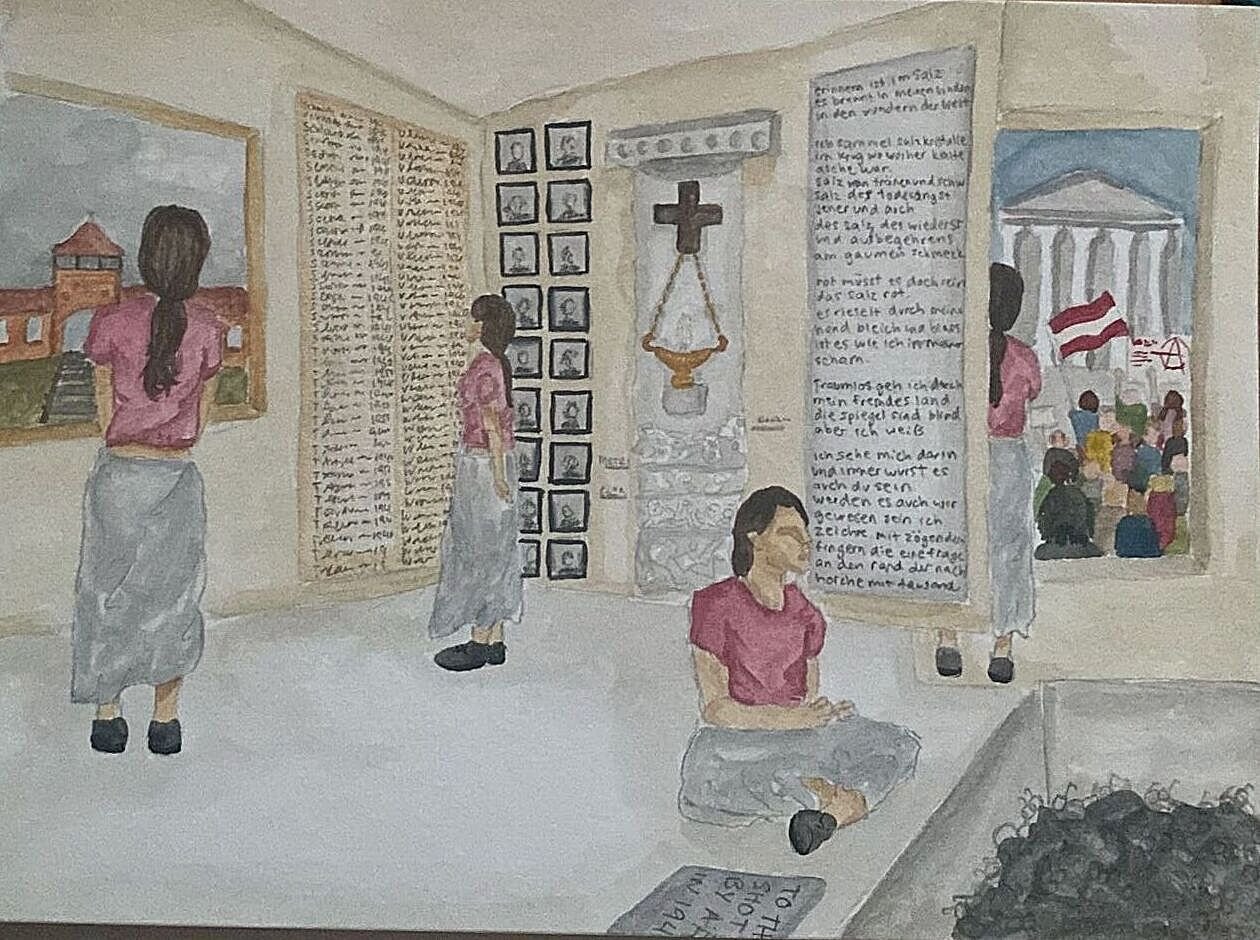
On the left, we see the haunting image of the gate to the Auschwitz-Birkenau death camp from where the guards of the concentration camp oversaw the march of hundreds of thousands into the gas chambers. This comes first due to it being the initial experience and biggest shock of the study tour. To its right, I painted the list of the murdered Jews of Auschwitz displayed in the Jewish exhibition pavilion, representing a never-ending inventory of those who disappeared in the Nazi terror as well as the personal moment people shared with such lists or plaques. For me, these moments were very intimate as I could find my Polish family name many times on the list of victims. Next to this list are the portrayals of those Auschwitz inmates, whom I described above, and which had such a lasting impact on me. In the centre is a sketch of the memorial that we encountered in Trieste, namely the Risiera di San Sabba, a former rice mill that was used as a Nazi concentration camp for political prisoners and a transit camp for Jews, many of whom were then deported to Auschwitz. There, we found a representation of the Holocaust and the Nazi regime that proved to be confusing and not factual. It stands for the misrepresentations and distortions that, partly politically motivated, we have seen in commemorating the Shoah.
Moving to the right again, we see the depiction of the poem at the Peršmanhof, situated in Bad Eisenkappel in Austria’s Carinthian region (the museum Peršmanhof is dedicated to the history and resistance of the Carinthian Slovenes during National Socialism). The poem tells the story of the horrific Nazi crime against the family of the farmhouse in the dying days of the Second World War. On April 25, 1945, a SS Police Regiment committed a massacre, killing innocent eleven civilians. The way this poem was placed in front of the photo of the dead family’s members was very thoughtful, as the poem proved to be equally devastating and encouraging with a view to its anti-fascist spirit. I found the dual impact innovative and important.
With the last image on the right, we move to contemporary debates about the legacy of the Holocaust and its political implications for contemporary society and politics. The drawing depicts anti-fascist and anti-racist activists in front of the Austrian Parliament Building, who challenge the traditional collective forgetting about the responsibility regarding the Nazi regime and the rise of a right-wing party that propagates an exclusionary nationalism as well as the hatred towards foreigners. In front, I decided to paint the unforgettable image of the countless shoes that were taken from the victims of the Auschwitz death camp and that are now on display at the Museum Auschwitz-Birkenau. This spectacle of clothes and human remains (hair) is both a haunting reminder of what humans are able to do to their fellow human beings and a statement that the victims are not entirely forgotten, that something remains from them bearing witness to an unconceivable crime against humanity.
Collective memory and political struggles
All these encounters left me wondering about the role of collective memory and how it relates to today’s social and political realities. Foremost, it became evident to me how significant practices or sites of commemorating history are in shaping collective memory. The study tour opened my eyes for how history is commemorated; sites that I would have not even noticed before took on a whole new meaning, - when contextualized in the history of a country and its historical narratives. In this respect, it became apparent that there is a major difference between history and the collective memory that captures this past selectively and is based on particular narratives (Halbwachs 1992). I learned how the interpretation of history speaks directly to how we as a society define ourselves and what kind of collective identity the national community selects. The study tour provided many vivid and often unsettling examples of how history is being used and misused by political actors.
One truly transformative encounter that I had during the study tour was the visit of the Slovenian Student Union (Klub slovenskih studentk) in Vienna. Until then I thought of memory politics primarily in terms of state actions and official memory sites such as memorials or museums. Yet, the club with the Slovenian students showed me how powerful memory activism from below can be. State officials do tell a story about the past and they promote a particular narrative that is convenient and not disruptive. Clearly, dealing with collective guilt regarding an historic injustice is never an easy task. Yet, in the Austrian context this led to a historical narrative (largely consensus well into the 1980s) that depicted the country as the first victim of Germany’s Nationalist Socialist regime irrespective of massive support with which the Anschluss was welcomed in Austria at the time. It took grassroots initiatives and courageous activist to challenge this narrative and accept responsibility for Austria’s complicity in the Nazi crimes.
Yet, to change a perspective on history and, for instance, give voice to those who are often not heard as victims, it normally needs those who challenge the official narrative and speak truth to power. In this respect, I was deeply impressed to see how important it is to young activists to draw public attention to what happened to Slovenians during National Socialism. Their political activism is a large part of their lives, and I found the labels they created in their political struggle (Antifa, Communist, Neoliberalism, etc.) fascinating and radical in a refreshing way (compared to the Canadian context where one would easily be considered an extremist). In Vienna, however, the need for resistance is so intense that these labels are seen more casual and rooted in the everyday struggle in the politicized youth community. Later this day, I was invited to a party of these history activists. There it became obvious how current their fight is. I met many activists, and many conversations were about current T.E.R.F protests as well as recurrent police violence. In the club, there were even signs saying “Machen Sie keine Fotos, helfen Sie nicht der Polizei” (Do not take pictures, don’t help the police), which once again demonstrates the intensity of the political divide.
In her work on Germany, Jenny Wüstenberg (2017) showed how such civil society activism is central for how societies struggle with a nation’s difficult past and how they become willing to address it. Her book argues that it is primarily due to the ‘memory activists’ in post-war German society that the country slowly faced its responsibility for the rise of National Socialism and the Holocaust. In the 1980s and 1990s, there were over hundred chapters across Germany to explore local history and come up with difficult questions. During the study tour, I received a sense of how powerful and transformative such local, grassroots initiatives can be.
Another very important encounter was the meeting with the Auschwitz survivor Zdzislawa Wlodarczyk. Hearing a testimony from someone who was imprisoned at the children’s quarter of the Auschwitz concentration camp that we had just visited was highly impactful. Her emotions and facial expressions spoke and described horrific experiences, even without translation, that are often beyond words and that no child should ever endure. Her story demonstrated the whole absurdity of the Holocaust as this woman and her family were not even in the groups primarily persecuted by the Nazi. She just had the misfortune to belong to a community that faced prosecution and mass murder by the Nazi regime. Her voice, her presence conveyed so directly and genuinely the suffering inflicted by the National Socialists in the name of racial superiority.
The encounter with the Holocaust survivor made me think about what will happen when the last eyewitnesses will no longer be able to share their stories with younger generation. Will the knowledge about what the Nazis did fade as a result or at least lose its immediate meaning for the presence? In their article, Popescu and Schult (2020) raise similar questions about what role performative commemorative practices could play in the 21st Century to keep the memory of the Holocaust alive and meaningful. I am wondering if, as Assmann (2010) argues, the Holocaust should be the foundation of a ‘global memory’ that could serve as a moral compass also for future generations. The study tour gave me a good sense that we are at a turning point regarding how and for whom this memory remains relevant.
At the Auschwitz concentration camp, I had an encounter that seems not very noteworthy at first sight, but it made me reflect for a long time: At many commemorative sites, visitors left their initials or some other graffiti-type message on walls or furniture. I felt that this defacement of a place like Auschwitz demonstrated a lack of respect that reflects a broader trend in society as well as potential lack of education. A visit to Auschwitz might be seen by some as a school shore or a convenient stop on a vacation tour through Poland. This attitude shows again how important but also difficult it is to convey the meaning of a place like Auschwitz, - and how important an initiative like the study tour is in particular for millennials.
The learning process during the study tour also spoke directly to my field of education at UVic. As a major in sociology, I analyze social forces that shape human behaviour and the way people interact. In this regard, the study tour provided me with fundamental questions that will continue to spark my curiosity as a student of sociology: How can we explain the power of political ideologies that bring individuals to engage in a behaviour that we would condemn based on basic moral principles (for instance, being imprisoned at the Auschwitz concentration camp or torturing political prisoners)? What does it take to ‘dehumanize’ a group of people to the degree that genocidal actions appear justifiable or at last acceptable? What is the ongoing attraction of authoritarian ideas and right-wing ideologies? At the end of the study tour, I had new appreciation of the role that historic narratives play in how we determine the moral principles by which we intend to live by as a political community.
Works cited
Assmann, Aleida (2010). The Holocaust – A global memory? Extensions and limits of a new memory community. In Memory in a Global Age, pp. 97-117. London: Palgrave Macmillan.
Berberich, Chrsitine (2021). Introduction: the Holocaust in contemporary culture. In Trauma & Memory (pp. 3-13). Routledge.
Hackmann, Jörg (2018). Defending the “good name” of the Polish nation: Politics of history as a battlefield in Poland, 2015–18. Journal of Genocide Research. 20: 587–606.
Halbwachs, Maurice (1992). On Collective Memory. Chicago: University of Chicago Press.
Jaskulowski, Krzysztof, and Piotr Majewski (2023). Populist in form, nationalist in content? Law and Justice, nationalism and memory politics. European Politics and Society 24: 4: 461-476.
Koselleck, Reinhart (2018). Sediments of Time: On Possible Histories. Series: Cultural Memory in the Present. Palo Alto, CA: Stanford University Press.
Pető, Andrea (2019). 'Non-Remembering' the Holocaust in Hungary and Poland. Polin Studies in Polish Jewry. 31: 471-480.
Popescu, Diana I., and Tanja Schult (2020). Performative Holocaust commemoration in the 21st century. Holocaust Studies. 26 (2): 135-151.
Uhl, Heidemarie (2017). The Politics of Memory: Austria’s Perception of the Second World War and the National Socialist Period." In Austrian historical memory and national identity, pp. 64-94. London: Routledge.
Verovšek, Peter J. (2021). Caught between 1945 and 1989: Collective memory and the rise of illiberal democracy in postcommunist Europe. Journal of European Public Policy 28: 840–75.
Wüstenberg, Jenny (2017). Civil Society and Memory in Postwar Germany. Cambridge: Cambridge University Press.
Alissa Schmidtke
Image: Auschwitz I Main Camp, Oświęcim, Poland (U.S. National Archives and Records Administration, NARA ID 305907). Created by U.S. Army Air Forces / National Archives photographers (historical aerial intelligence photography, 1944). This work is in the public domain (U.S. Government work, NARA collection). No changes have been made
